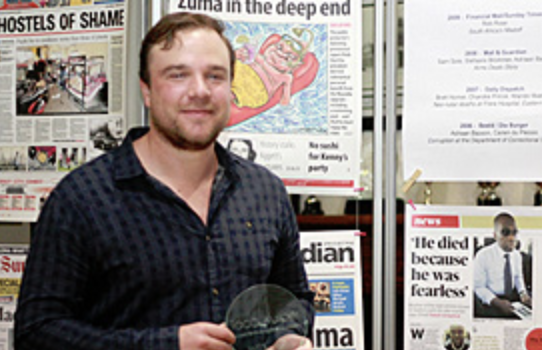
Reminder to enter SADC media awards
Entries for the 2016 Southern African Development Community (SADC) media awards close on 29 February.
The objective of the awards is to promote regional integration and cooperation through excellence in journalism. They are also aimed at encouraging media practitioners in SADC member states to cover issues pertaining to the region.
The competition has four categories namely print, photojournalism, television and radio.
Journalists who wish to enter the competition can download the entry form and competition rules.
For more information contact Themba Sepotokele on 082 490 9869 or Mmemme Mogotsi on 072 856 4288.
For fact-checking to be sustainable, fact-checking organisations need to become obsolete
Written by Nechama Brodie and published on Poynter.org
In mid-January 2016, the office of the Presidency of the Republic of South Africa issued a public correction for a minor error that had been included in a speech delivered by the president, Jacob Zuma, at a business gala dinner the previous month.
The correction was about the size of the continent of Africa. In his speech Mr Zuma had claimed Africa was the “biggest continent in the world”; in his correction he admitted that, by population, Africa would indeed only be considered the second-biggest after Asia. “The President regrets the error,” the statement read (neglecting, sadly, to take the opportunity to correct the additional overstated claim that all the continents put together would “fit into Africa”).
The correction itself was an unusual enough act to be noticed; the question about Africa’s size less so. One of the very first reports researched by Africa Check was on the question of exactly how many countries there are in Africa. (The answer is not straightforward). Still, it seemed significant that, as 2016 began, one of Africa’s most powerful leaders appeared to be aware of the importance of getting their facts straight in public.
In the preceding months the issue of fact-checking and corrections had also been raised very prominently by newspaper editors in South Africa and in Kenya. Except that in these cases their calls had been for improved fact-checking processes in the media. Both Ferial Haffajee, the editor-in-chief of South Africa’s City Press, and Peter Mwaura, public editor of Kenya’s Daily Nation, singled out Africa Check as the benchmark for such exercises. Ms Haffajee called Africa Check the continent’s “accuracy watchdog” and, following a series of errors in her own newspaper, announced that, among other measures, she would be asking Africa Check to train her reporters on improved fact-checking protocols.
Facts don’t have borders
Fact-checking in Africa is no different from fact-checking in any other part of the world. There is no empirical evidence that Africa (a continent, not a country remember) is any more, or less, honest than any other region of the world. One only needs to look at the proliferation of fact-checkers around the world to see that bad data has no respect for international borders. Even if we have to measure overtly “dishonest” factors like corruption in Africa, typically these metrics assess only perceptions of graft – and, as every fact-checker ought to know, you can’t fact-check an opinion.
There exist rich sets of data on most, if not all, African countries. Finding the information, however, is not always easy, whether reporting on Africa or checking reports on Africa. In response to this, Africa Check is developing a new Info Finder service to help point its readers to sources of useful data in key countries around the continent.
At the same time, convincing people that this information a) is available and b) that it is adequate to be used is also hard. Certainly, there is a residual mistrust of African-led data that extends not only across African media but is strongly evident in the foreign media’s reporting on the continent and individual African countries. In the past nine months Africa Check has discovered significant errors in reporting on South Africa that appeared in the UK’s Telegraph, the New York Times, and, most recently, international broadcaster Sky News. While the latter report has been quietly removed from the broadcaster’s website, as yet none of the respective media outlets have admitted their errors or published corrections.
Fact-checking is not just about politics
The approach of the US presidential elections has pushed political fact-checking into a specific prominence, and raised parallel questions about the relevance of fact-checking in general. Recent articles on Poynter have asked, deliberately, why many fact-checking organisations fail – and, whether anyone cares about fact-checking anyway?
Africa Check’s own founding story shows this need not all be about politics. More than a decade ago the people of northern Nigeria experienced an upsurge in polio (that then spread to other countries across the Sahel and further afield), following false claims that vaccination campaigns were part of a Western plot to make Muslim women infertile. These claims were published (as “news”), unchecked, by the local media. Although corrections were subsequently printed, they came too late; it would take more than a decade for the country to recover to previous polio levels. Nigeria is still not polio-free.
The false claims about the polio vaccine were not all made by politicians, but by religious leaders and others in the media. So, when Africa Check was founded in 2012 (by journalist Peter Cunliffe-Jones, a former AFP Lagos bureau chief who had been in Nigeria at the time), it was agreed to focus on all of these sectors – politics, public and media. This also informed Africa Check’s decision to provide its reports free of charge to other news organisations, establishing Africa Check not only as Africa’s first fact-checking concern but, in a sense, as a functional fact-checking wire service.
For Africa Check there is a dual benefit in this arrangement. First, it allows our content to be widely distributed. Second, by providing our content to others, we enable others to understand and perhaps even replicate similar fact-checks.
Built-in obsolescence?
To date, almost all Africa Check’s funding has come from half a dozen different donor institutions. While funding has grown sharply, we are constantly looking for ways to become less dependent on our donors.
In 2015 Africa Check established a commercial training, research and information division, TRi Facts. This unit operates separately from Africa Check’s editorial team, providing training and research services to clients in the media, education and business sectors.
Before TRi Facts had even officially launched, it had been booked to train nearly 100 cadet journalists and community newspaper editors at one of South Africa’s largest newspaper groups, Caxton & CTP Publishers. Over the next nine months TRi Facts conducted similar training at three other major South African national news organisations: EWN, Times Media, and Africa’s largest media company, Media24. TRi Facts is currently negotiating fact-check training for both professional and citizen journalists not just in South Africa but in Kenya and Nigeria, and hopes to soon expand its programme to include youth reporters.
The growing demand not just for fact-checking but for fact-check training has multiple benefits for Africa Check: not only will it allow the organisation to become (at least partially) self-funded, it could also – perhaps more importantly – have the effect of reducing the need for separate fact-checking organisations over time. As Poynter’s Alexios Mantzarlis says, “fact-checking emerged as a standalone industry because other journalists weren’t fulfilling that role anymore and will die (happy) when journalists return to it across the board.”
This is perhaps counter-intuitive, but the mandate of fact-checking operations should never focus exclusively on correcting misleading claims. The ultimate goal should rather be kick-starting their readers’ sceptical reflexes, and enabling them, and those in the media, to question and check claims for themselves. Fact-checkers and fact-checking organisations are also not infallible, nor are they omnipotent: they cannot be on every computer, every mobile phone, every street corner or community hall. If fact-checking is niche, then it will never be relevant or effective.
This approach – a planned (if still distant) redundancy – is important to and has even been welcomed by our funders, and rightly so. It also firmly places fact-checking as a form of sustainable social enterprise (the old “teaching a person to fish” cliché) rather than a charity service, or gimmick employed by commercial media.
At its core, fact-checking should enable a shift in thinking and skills. Not about this or that claim, but in teaching people to ask better questions and to find and use the best sources of information themselves.
From the regulators
An update about the rulings of the Press Council and Broadcasting Complaints Commission of SA.
When permission is not enough
No good deed goes unpunished, the proverb dictates.
eTV was reminded of this when it aired a programme in October about the Berea-Hillbrow Home of Hope, a children’s home, as part of its reality series “She is the One”. The intent was pure: contestants in the programme volunteered their time at the home and eTV obtained permission from the head of the children’s home to film there.
But, as is often the case, the complaint didn’t come from a subject of the broadcast. A lecturer of Wits University watched the programme and objected to the fact that some of the children’s faces were shown in the broadcast. The lecturer said although the programme intended to raise awareness of the plight of the children, it put the children in jeopardy as some of them were victims of abuse and trafficking.
eTV tried to make out several arguments why the broadcast wasn’t a contravention of the Broadcasting Code requiring “special weight to the privacy of children” (clause 15(3)).
Our regulators take a particularly harsh approach in complaints involving children. (See, for example, the Press Council case of Nadine Hamman v Huisgenoot where a minor accused was identified not as the accused, but as a victim. The Council held on appeal that it was not in the child’s best interest, even where there was permission from the legal guardian.)
The stance of the regulators is clear: laws and ethical rules protecting children are there for a reason and there is absolutely no tolerance for bending the rules. Not even with good intentions.
Children who are accused of a crime or who are in need of care and protection may under absolutely no circumstances be identified – not even through a “loophole” by withholding the fact that the child is an accused or a child in need of care.
In theory, the Press Code makes provision for the identification of children who are survivors of sexual violence (clause 3.4), who want to disclose their HIV/AIDS status (clause 3.5) and even children who are accused of a crime (clause 8.3). This is all with the caveat that there must be permission from the child and their legal guardian, there must be an “evident public interest” and, all importantly, “it is in the best interest of the child”.
The BCCSA, on the other hand, now said in the eTV judgment that it is simply not possible to contract out of law ie the head of the children’s home was in no position to give such consent as the law (Children’s Act) prohibits the children’s identification. Permission is therefore no defence.
The moral of story is that children should raise red flags for all journalists. If it is not absolutely imperative for the story, in the public interest and in the interest of the child, rather don’t identify children in media coverage.
More on the identification of children in the media in a next edition. eTV was found to have breached the Code, but got off on a warning. Read the full BCCSA judgement.
The Brief
Herman Scholtz*
In journalism school, I was taught it is a deadly sin of journalism to record a conversation without informing the interviewee. As it turns out, it is a common misconception in newsrooms that there is something sinister about recording telephone calls.
The myth is perpetuated by call centres bombarding you with warning messages that “this call may be recorded for quality control and security purposes”, whatever the cliché means. Call centres do that for contract purposes and compliance with consumer and privacy legislation that is not important in the journalism universe.
The legal position for journalists is quite clear: As long as you are actually a party in the conversation – whether telephonically or in person – you are allowed to record it without the permission from any of the other parties.
The Regulation of Interception of Communications and Provision of Communication-Related Information Act (the dreaded RICA) makes it an offence to “tap” phone calls or “hack” communication a la News of the World. But s4(1) of the Act states: “Any person, other than a law enforcement officer, may intercept any communication if he or she is a party to the communication, unless such communication is intercepted by such person for purposes of committing an offence.”
Eavesdropping and physically entering spaces to listen to a conversation of which you are not a party is, however, likely to be an infringement of privacy in terms of the common law.
But should you want to record telephonic or personal interviews for accuracy purposes, go ahead.
For landline calls, there is a special adaptor on the market that connects the headpiece to a recording device such as a dictaphone. A cheaper alternative is to make calls on speaker mode and record both sides of the conversation with your dictaphone. Windows has a nifty standard voice recorder that will save the file as an MP3 upon completion – ready to be archived.
For mobile calls, there are several apps on the market for Android, Windows and iOS cellphones. Read a review of some of the apps.
Scholtz is news editor of Rapport. He holds the degrees BCom LLB, BA (Media Studies), BPhil (Journalism) and is completing his LLM (Information and Communications Law) in February.
PRISM Awards entries go online
The PRISM Awards has ditched its paperwork and moved the entry system for the 2016 awards exclusively online. The deadline for entries is 15 February 2016, with the awards ceremony scheduled for Sunday, 17 April 2016.
Now in its 19th year, the PRISM Awards are presented to public relations and communication professionals who have successfully incorporated strategy, creativity and professionalism in public relations and communication programmes and strategies that showcase a successful public relations campaign.
“It is now easier than ever to enter the PRISM Awards,” says PRISM Awards Convenor, Bridget von Holdt. “Entrants can look forward to a far more convenient, cost-effective, simpler and quicker process than in previous years.”
Whilst the new system will benefit all entrants into the awards, it will also streamline the entire awards process: improving response times and accuracy, whilst reducing inefficiencies. “Online entries are the first phase in making the PRISM Awards more streamlined,” says von Holdt. “We are also considering taking the judging process online.”
To enter online visit www.prisa.co.za.
Feedback
Please send any news, suggestions or information for this newsletter to Martin van Niekerk at the secretariat on martin@nationalpressclub.co.za, 082 257 0305. Website | Facebook | Twitter